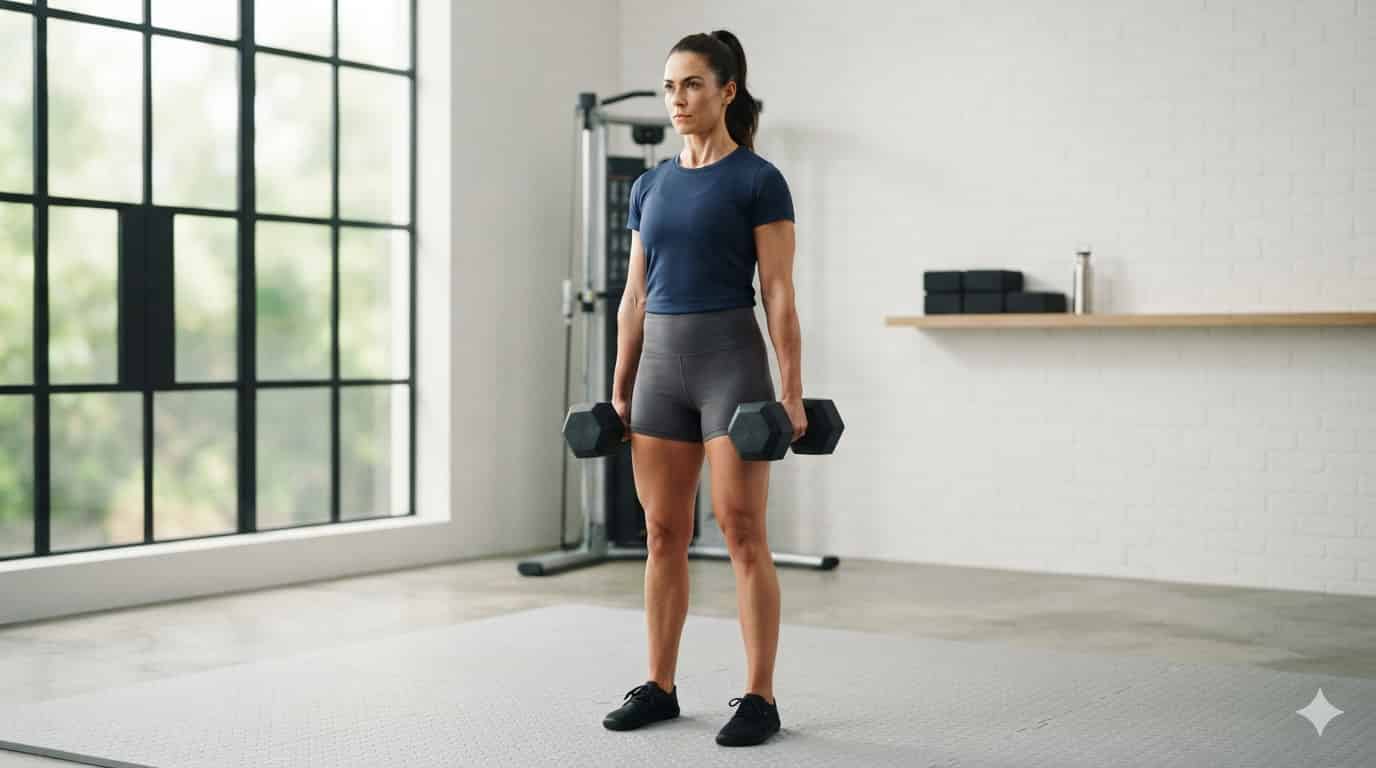
Finding effective farmers walk alternatives for grip strength allows you to build powerful forearms, trap thickness, and core stability without needing a 50-foot open walking lane. The traditional farmer’s walk—picking up two immensely heavy weights and walking for distance—is universally hailed as the gold standard of real-world functional conditioning.
While the traditional loaded carry is unmatched for full-body tension, executing smart farmers walk alternatives for grip strength delivers identical crushing hand power in tight home spaces. Commercial gyms are often overcrowded with lifters blocking runways, and compact apartment home gyms rarely possess more than six feet of open floor clearance. Furthermore, dropping 80-pound dumbbells while maneuvering around narrow living room furniture creates an unnecessary hazard.
Whether you train in a compact garage, want to fix your deadlift grip plateau, or desire thick forearms without pacing back and forth, here are the 7 proven stationary alternatives to build unbreakable grip and postural endurance.
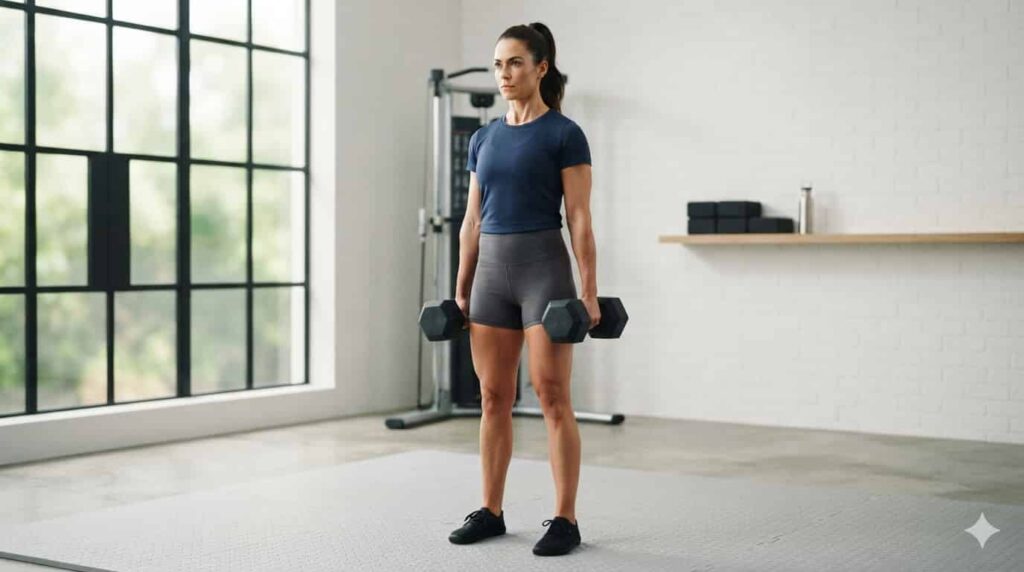
Why You Need Farmers Walk Alternatives for Grip Strength
Many home gym lifters search for farmers walk alternatives for grip strength because navigating crowded commercial floors or narrow apartment hallways with heavy iron weights is impractical.
Beyond spatial restrictions, stationary grip builders deliver three distinct physiological advantages:
- Elimination of Trip Hazards: Walking while carrying your near-maximal body weight places high rotational torque on your ankles if you clip an obstacle or stumble.
- Pure Tension Without Gait Dissipation: Striding dissipates some muscular tension through hip sway; standing completely motionless forces 100% of the isometric load into your fingers, forearms, and mid-traps.
- Specific Grip Adaptations: Traditional carries primarily train support grip; creative alternatives allow you to overload pinch grip, crush grip, and thick-bar open-hand strength.
Adopting targeted farmers walk alternatives for grip strength guarantees that you forge rugged, functional upper-body power within a zero-footprint floor space.
7 Proven Farmers Walk Alternatives for Grip Strength for Forearm Power
1. Static Heavy Dumbbell Suitcase Holds (Zero-Footprint Overload)
As the most direct substitute among farmers walk alternatives for grip strength, the unilateral suitcase hold matches the core and hand demand of loaded carries in a zero-footprint stance. Holding a heavy dumbbell on only one side forces your opposing internal and external obliques to contract violently to keep your spine vertical.
- Target Muscles: Forearm flexors, obliques, quadratus lumborum (QL), traps.
- Equipment Needed: One heavy dumbbell or kettlebell.
How to Perform:
- Stand tall with feet shoulder-width apart, holding a heavy dumbbell in your right hand.
- Squeeze your left fist tight at your side to create full-body tension through muscular irradiation.
- Lock your shoulders down and back, maintaining a perfectly vertical posture without leaning to the right.
- Hold for 30 to 45 seconds of pure isometric tension before switching hands.
2. Timed Dead Hangs from a Pull-Up Bar
Utilizing gravity for passive bar hangs provides one of the purest farmers walk alternatives for grip strength while simultaneously decompressing spinal discs. Holding your entire body weight suspended challenges your finger flexors against smooth steel while opening up stiff shoulder capsules.
- Target Muscles: Flexor digitorum profundus, lats, grip stabilizers.
- Equipment Needed: Sturdy overhead pull-up bar.
How to Perform:
- Grip an overhead bar with a full overhand grip, wrapping your thumbs completely around the circumference.
- Step off the platform and hang with arms fully extended.
- Keep your core gently braced and breathe smoothly through your nose.
- Aim for 45 to 60 seconds; add a weight vest once a one-minute bodyweight hang feels easy.
(Affiliate Tip: Ideal spot to recommend doorway pull-up bars and liquid chalk).
3. Smooth-Side Weight Plate Pinches
Performing smooth-side plate pinches stands out as one of the best pinch-grip farmers walk alternatives for grip strength to target thumb adductors. Standard dumbbell handles train fingers in a curled hook; plate pinching isolates the opposing thumb and extensor muscles that traditional handles ignore.
- Target Muscles: Thenar muscles (thumbs), finger extensors, wrist stabilizers.
- Equipment Needed: Two smooth cast-iron or bumper weight plates (5 to 15 lbs each).
How to Perform:
- Place two smooth weight plates together with their flat, smooth sides facing outward.
- Pinch the tops of both plates between your fingers and thumb—do not hook your fingers under the rim.
- Stand tall, deadlift the plates off the floor, and hold them at your side for 20 to 30 seconds.
- The moment the plates begin slipping, set them down under control.
4. Thick-Towel Pull-Up Bar Holds
Wrapping thick towels around a bar creates intense farmers walk alternatives for grip strength that challenge wrist flexors through thick-bar mechanics. Thick grip diameters prevent your fingers from locking into a closed fist, demanding three times more motor unit recruitment.
- Target Muscles: Deep forearm flexors, brachioradialis, wrist pronators.
- Equipment Needed: Pull-up bar, two heavy cotton hand towels.
How to Perform:
- Drape two thick towels over a pull-up bar, shoulder-width apart.
- Grip the hanging towel ends firmly with a vertical, neutral grip.
- Lift your feet and hang suspended, squeezing the fabric as hard as humanly possible.
- If full hangs are too difficult, keep your feet lightly touching the floor to modulate resistance.
(Affiliate Tip: Great spot to link to silicone thick-bar grip adapters like Fat Gripz).
5. Stationary Trap Bar (Hex Bar) Static Holds
Loading a trap bar for stationary holds delivers heavy overload among farmers walk alternatives for grip strength without tripping hazards. The neutral handle alignment of a hex bar allows you to handle 200+ pounds comfortably without bruising your outer thighs.
- Target Muscles: Upper traps, finger flexors, erector spinae.
- Equipment Needed: Trap bar (hex bar), Olympic weight plates.
How to Perform:
- Step inside a loaded trap bar, hinge your hips, and grip the handles firmly.
- Stand up tall into a full lockout, pinning your shoulder blades down into your back pockets.
- Stand completely motionless for 30 to 40 seconds, fighting the barbell’s urge to rip out of your palms.
- Lower the bar smoothly back to the floor.
Pairing functional grip training with cardiovascular conditioning like achieving cardiorespiratory fitness elevates oxygen delivery and accelerates metabolic waste clearance from overworked forearm muscles.
6. Kettlebell Bottoms-Up Clean and Hold
Balancing an inverted kettlebell upside-down demands radical neuromuscular precision. If your grip slacks for a fraction of a second, the bell flips over immediately, teaching you how to crush handles with maximum intent.
- Target Muscles: Rotator cuff stabilizers, wrist flexors, serratus anterior.
- Equipment Needed: Light-to-moderate kettlebell (10 to 25 lbs).
How to Perform:
- Clean a kettlebell up into a bottoms-up position, where the heavy bell rests balanced upside-down in the air.
- Squeeze the handle with white-knuckle intensity, pinning your elbow tight against your front ribs.
- Hold this rigid isometric position for 20 seconds per arm without letting the bell tilt.
For home gym enthusiasts outfitting space-efficient studios, pairing functional grip work with foldable Pilates machines for home workouts builds comprehensive full-body joint alignment and core endurance.
7. Heavy Barbell Finger Curls (Behind the Back)
Holding a barbell behind your glutes and allowing it to roll down to your fingertips before curling it back into a closed fist builds localized forearm muscle mass.
- Target Muscles: Flexor digitorum superficialis, wrist flexors.
- Equipment Needed: Barbell, light-to-moderate weight.
How to Perform:
- Stand tall holding a barbell behind your back with an overhand grip.
- Open your fingers slowly, letting the bar roll down toward your distal knuckles.
- Use pure finger flexion to curl the bar back up into your palms, squeezing hard at the top.
- Perform 3 sets of 15 controlled repetitions.
Biomechanics: How Farmers Walk Alternatives for Grip Strength Build Total-Body Tension
The physiological brilliance of these farmers walk alternatives for grip strength lies in irradiating neural drive from your fingers through your rotator cuffs and abdominal wall.
| Exercise | Primary Grip Type | Core / Oblique Activation | Space Required | Best For |
| Traditional Farmer’s Walk | Support Grip | Moderate | 50+ Feet (Large) | Heavy outdoor carries |
| Suitcase Hold | Support Grip | Extremely High | Zero Feet (Stationary) | Small spaces & Core |
| Timed Dead Hang | Support / Hook Grip | Moderate | Overhead bar | Shoulder health & lats |
| Plate Pinches | Pinch Grip (Thumb) | Low | Zero Feet | Thumb & extensor balance |
| Thick Towel Hangs | Open-Hand Support | Moderate | Overhead bar | Forearm hypertrophy |
| Bottoms-Up Hold | Crush Grip | High | Zero Feet | Wrist & rotator cuff stability |
Weekly Programming and Grip Overload Rules
Integrating these targeted farmers walk alternatives for grip strength twice a week eliminates grip failure on deadlifts and barbell rows.
Follow these three implementation rules:
- Train Grip at the End of Workouts: Never perform heavy grip-fatiguing holds before heavy deadlifts, pull-ups, or rows; fatigued hands will compromise your primary compound lifts.
- Vary Grip Types Weekly: Alternate between support grip (Suitcase Holds), pinch grip (Plate Pinches), and thick-grip challenges (Towel Hangs) to prevent repetitive strain injuries.
- Never Use Lifting Straps on Grip Builders: Save your lifting straps for heavy back sets; when executing grip-focused work, rely 100% on bare hands and chalk.
Practicing these adaptable farmers walk alternatives for grip strength proves that forged forearm endurance requires nothing more than smart stationary loading.
Connect With Us & Share Your Progress
For practical functional strength guides, home gym setups, and active wellness tips, join our growing digital fitness community:
- Follow our visual exercise routines on FitKiter on Pinterest
- Join our community fitness discussions on FitKiter on Facebook