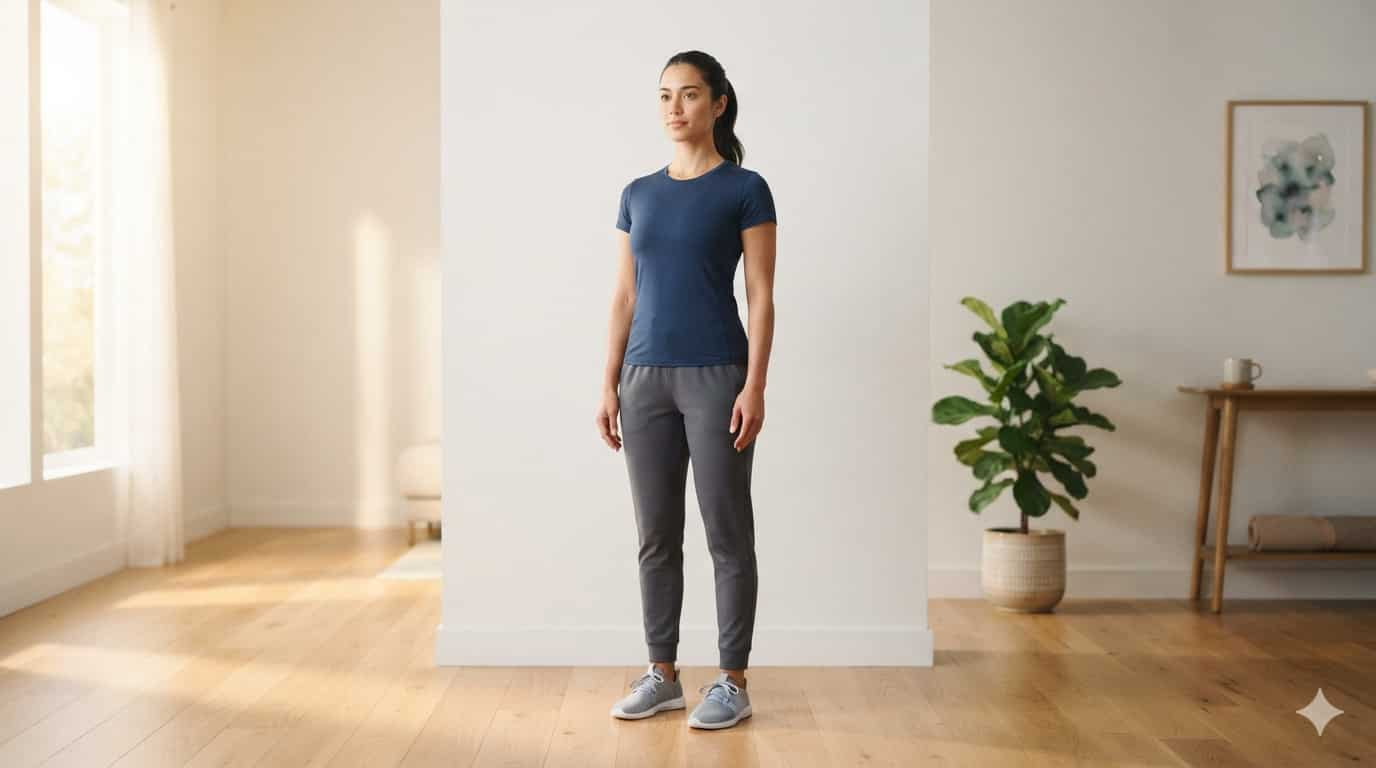
Learning how to fix rounded shoulders at home is essential when prolonged desk sitting, smartphone scrolling, and slumped posture pull your upper spine into chronic flexion. In modern sedentary society, the human upper body spends hours frozen in an internal rotation pattern: the shoulders roll forward, the chest collapses, and the head juts outward like a turtle. Over time, this repetitive mechanical posture causes the pectoralis minor to shorten into rigid tissue, while the rhomboids and lower trapezius become chronically overstretched and neurologically inhibited.
While wearable posture braces offer temporary feedback, committing to active exercises to fix rounded shoulders at home reprograms your central nervous system to hold scapular retraction naturally. Slapping on an elastic posture harness acts like a crutch; it artificially holds your bones in place while allowing your postural stabilizer muscles to weaken even further.
Whether you want to eliminate nagging upper-back tension, look taller and more confident in clothes, or protect your rotator cuffs during bench presses, here is the clinical, 5-step movement blueprint to correct postural slumping without visiting a physical therapy clinic.
The Science of Upper Crossed Syndrome: Why You Must Fix Rounded Shoulders at Home
When patients ask physical therapists how to fix rounded shoulders at home, the conversation always begins with muscle imbalance: hypertonic chest muscles pulling against inhibited rhomboids.
This postural distortion was first classified by pioneering Czech neurologist and physician Dr. Vladimir Janda, who termed it Upper Crossed Syndrome.
“Muscles are organized in functional pairs. When tonic postural muscles—such as the pectoralis minor and upper trapezius—are placed under chronic continuous shortening, they send an inhibitory neurological signal that shuts down their opposing phasic partners: the deep neck flexors and middle-to-lower trapezius.”— Dr. Vladimir Janda, M.D., Founder of Clinical Sensorimotor Rehabilitation.
This muscular tug-of-war causes the head of your humerus (upper arm bone) to glide forward and upward inside the glenoid socket, leading to chronic subacromial impingement, rotator cuff friction, and shallow breathing patterns. Understanding fix rounded shoulders at home principles requires addressing both sides of the joint: lengthening the short anterior chest tissues while forcefully reactivating the dormant posterior back muscles.
5 Doctor-Approved Drills to Fix Rounded Shoulders at Home
1. Prone Floor Y-T-W Scapular Raises (The Scapular Awakener)
Incorporating prone floor raises allows you to fix rounded shoulders at home by reactivating dormant lower trapezius and rhomboid fibers. Lying face down on the floor removes gravity’s pull on your spine, allowing you to isolate pure scapular retraction and upward rotation.
- Target Muscles: Lower and middle trapezius, rhomboid major/minor, rear deltoids.
- Equipment Needed: Floor mat.
How to Perform:
- Lie face down on an exercise mat with your forehead resting lightly on a folded towel to keep your neck neutral.
- Extend your arms overhead at a 45-degree angle in the shape of a “Y”, thumbs pointing toward the ceiling.
- Squeeze your shoulder blades down and back, lifting your hands 3 to 4 inches off the floor using your upper back.
- Hold for 2 seconds, lower slowly, and perform 10 repetitions.
- Move your arms straight out to the sides into a “T” position and repeat for 10 reps.
- Bend your elbows to 90 degrees in a “W” position, pinching your shoulder blades together for a final 10 reps.
2. Doorway Pectoralis Minor Release with External Rotation
Releasing shortened pectoralis minor fibers is a vital prerequisite to fix rounded shoulders at home before attempting scapular strengthening. If your chest muscles remain wound tight like steel cables, your back muscles cannot physically pull your shoulder blades flat against your ribcage.
- Target Muscles: Pectoralis minor, sternal pectoralis major, anterior deltoid.
- Equipment Needed: Standard interior doorframe.
How to Perform:
- Stand inside an open doorway and place your right forearm flat against the doorframe, with your elbow bent at 90 degrees.
- Step forward with your right foot into a gentle split stance.
- Without twisting your lower back, lean your chest forward until you feel a firm stretch across the front of your shoulder.
- Turn your head slightly to the left to amplify the fascial stretch along the collarbone.
- Hold for 45 seconds of slow nasal breathing, then switch to the left arm.
3. Precision Wall Angels with Lumbar Contact
Practicing Wall Angels provides one of the strictest biomechanical tests to fix rounded shoulders at home through full thoracic articulation. It exposes hidden rotational restrictions in the glenohumeral joint while demanding thoracic spine extension.
- Target Muscles: Serratus anterior, lower trapezius, thoracic extensors.
- Equipment Needed: Smooth flat wall.
How to Perform:
- Stand with your heels, glutes, upper back, and back of your head resting flat against a wall.
- Flatten your lower back so there is zero gap between your lumbar spine and the drywall.
- Bring your arms up into a “goalpost” position (elbows at 90 degrees), pressing the backs of your elbows and wrists against the wall.
- Slide your hands upward into a “V” overhead, keeping your wrists, elbows, and lower back glued to the wall.
- Slide back down smoothly to the ribs. Perform 12 slow, disciplined repetitions.
4. Band-Resisted Pull-Aparts and External Rotations
Using light elastic bands to fix rounded shoulders at home trains the infraspinatus and teres minor to rotate humerus heads back into neutral sockets. The rotator cuff muscles pull the head of the arm bone backward, preventing forward-rounded slouching.
“You cannot put your shoulders into an organized, stable position if your thoracic spine is rounded like a frightened turtle. Squeezing your glutes, setting your ribcage over your pelvis, and externally rotating your arms creates the stable joint capsule required to prevent impingement.”— Dr. Kelly Starrett, DPT, Physical Therapist and Author of Becoming a Supple Leopard.
- Target Muscles: Infraspinatus, teres minor, posterior deltoid.
- Equipment Needed: Light continuous-loop resistance band.
How to Perform:
- Stand tall holding a light resistance band in front of your chest with hands shoulder-width apart, palms facing up.
- Lock your ribs down and pull the band apart horizontally until it lightly touches your sternum.
- Consciously focus on rotating your thumbs backward at peak stretch.
- Hold the squeeze for 2 full seconds before returning under control over a 3-second negative.
- Complete 3 sets of 15 repetitions.
(Opove M3 Pro 2 Massage Gun Deep Tissue for Workout Recovery, Black).
5. Supine Double-Chin Tucks (Deep Cervical Flexion)
Integrating deep cervical neck flexor activations ensures your efforts to fix rounded shoulders at home eliminate forward-head “text neck” permanently. For every inch your head drifts forward past your shoulders, your cervical spine absorbs an extra 10 pounds of gravitational pressure.
- Target Muscles: Longus capitis, longus colli (deep neck stabilizers).
- Equipment Needed: Floor mat.
How to Perform:
- Lie flat on your back on the floor with knees bent.
- Without lifting the back of your head off the mat, gently draw your chin straight down toward your throat as if creating a “double chin.”
- You will feel a lengthening stretch along the base of your skull and an active contraction deep in the front of your neck.
- Hold the isometric squeeze for 5 seconds, release smoothly, and repeat for 15 reps.
Pairing daily upper-body postural resets with consistent desk exercises for lower back pain keeps your entire spinal column decompressed during grueling 8-hour computer workdays.
Biomechanics: How Targeted Drills Fix Rounded Shoulders at Home
The underlying kinetic secret of how these movements fix rounded shoulders at home is reciprocal inhibition, where activating the posterior back muscles forces tight anterior chest muscles to reflexively relax.
| Drill | Primary Action | Target Muscle Group | Daily Prescription |
| Prone Y-T-W | Scapular Retraction & Depression | Lower Traps & Rhomboids | 10 reps per letter |
| Doorway Pec Stretch | Fascial Elongation | Pectoralis Minor & Major | 45 seconds per arm |
| Wall Angels | Thoracic Extension & Gliding | Serratus Anterior & T-Spine | 12 strict reps |
| Banded Pull-Aparts | Glenohumeral External Rotation | Infraspinatus & Rear Delts | 3 sets of 15 reps |
| Chin Tucks | Cervical Axis Re-alignment | Deep Neck Flexors (Longus) | 15 reps (5s hold) |
Maintaining strong whole-body muscular endurance through achieving cardiorespiratory fitness elevates tissue oxygenation and accelerates cellular recovery throughout overworked spinal stabilizers.
Ergonomic Daily Habits to Permanently Fix Rounded Shoulders at Home
Executing these five targeted movements consistently to fix rounded shoulders at home guarantees that you stand taller, breathe deeper, and project confident physical alignment every single day.
To ensure your postural gains remain permanent:
- Elevate Your Laptop Display: Position your computer monitor so that the top third of the screen is at direct eye level, preventing downward neck slumping.
- Keep Elbows at 90 Degrees: Adjust your office chair armrests so your forearms rest naturally without your shoulders shrugging up toward your ears.
- The 45-Minute Posture Alarm: Stand up once every 45 minutes, walk across the room, and perform 10 standing doorway arm sweeps to reset upper-body blood flow.
Restoring upright upper-body alignment eliminates chronic neck headaches, protects your rotator cuff tendons, and revitalizes your daily energy naturally.
Connect With Us & Share Your Progress
For practical posture guides, joint longevity routines, and active wellness tips, join our growing digital fitness community:
- Follow our visual exercise flows on FitKiter on Pinterest
- Join our community mobility discussions on FitKiter on Facebook