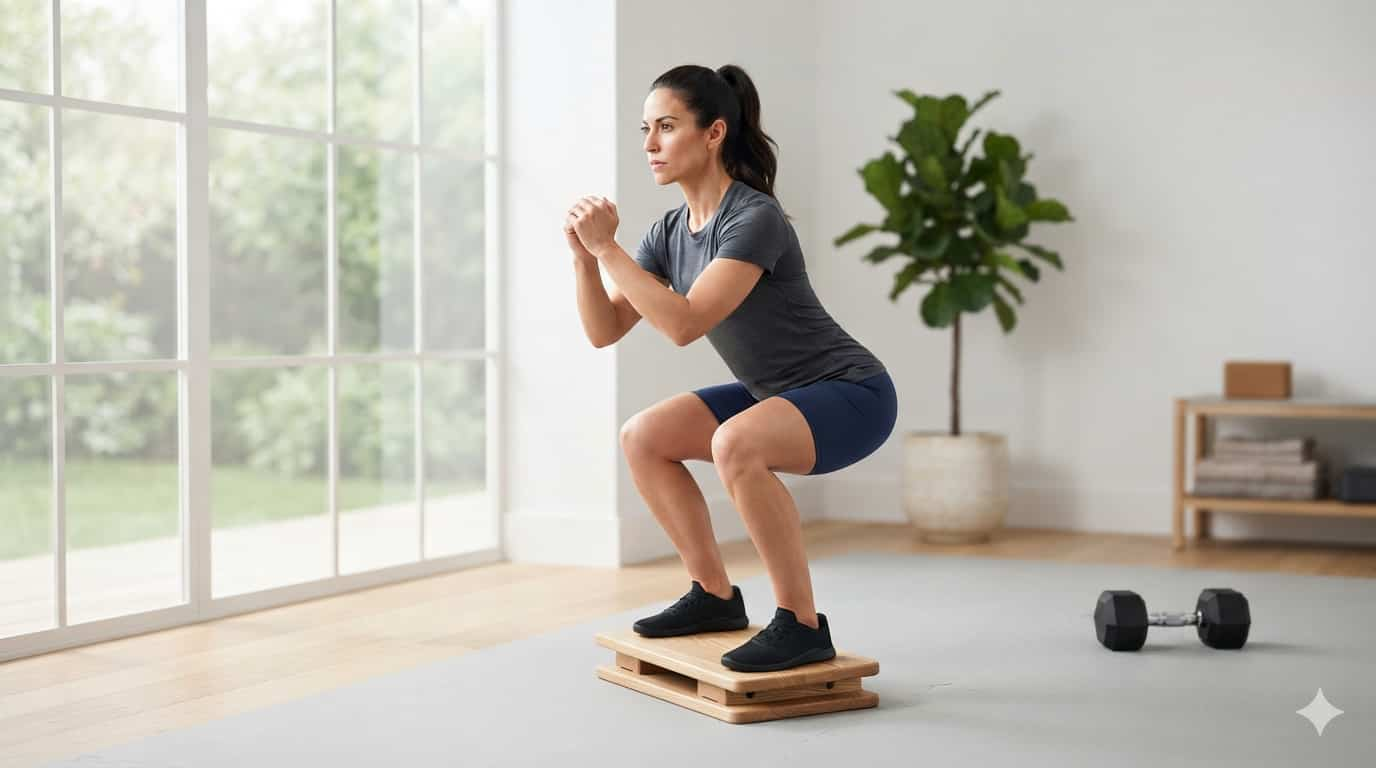
Practicing targeted multi angle ankle slant board exercises is one of the most effective ways to eliminate chronic patellar tendonitis, lengthen tight calf complexes, and build deep squat mobility at home. For decades, athletes were told that the knees should never travel past the toes during lower-body training. However, modern biomechanical research and athletic longevity specialists have proven the exact opposite: deliberately training knee flexion over toes builds thick, resilient tendon tissue capable of absorbing high-impact forces.
While flat-ground stretching often fails to isolate deep ankle dorsiflexion, utilizing progressive multi angle ankle slant board exercises allows you to alter mechanical leverage to match your exact joint prerequisites. An adjustable multi-angle slant board—which typically pivots between 20, 30, 35, and 40 degrees—removes the restrictive ankle mobility bottleneck that forces your hips and lower back to compensate during deep movements.
Whether you are recovering from runner’s knee, rehabilitating an Achilles tendon strain, or looking to unlock an effortless rock-bottom squat, here are 7 proven exercises to bulletproof your lower legs using an adjustable slant board.
Why You Need Multi Angle Ankle Slant Board Exercises
Many runners and lifters struggle with restricted ankle mobility, but executing consistent multi angle ankle slant board exercises forces the gastrocnemius, soleus, and Achilles tendon to stretch under active load.
When you stand on an inclined wedge, three distinct biomechanical advantages immediately take place:
- Elimination of Ankle Dorsiflexion Bottlenecks: Elevating the heel reduces the required forward ankle bend, allowing your torso to remain completely vertical while your knees travel forward naturally.
- Targeted VMO Isolation: Shifting the center of mass forward concentrates mechanical tension directly onto the vastus medialis oblique (the teardrop quad muscle), which stabilizes the patella inside the femoral groove.
- Connective Tissue Remodeling: Eccentric loading on an angled slope stimulates collagen synthesis inside the patellar tendon and plantar fascia, accelerating tendon healing.
Adopting regular multi angle ankle slant board exercises ensures you build bulletproof lower-body resilience without compromising your lumbar spine.
7 Proven Multi Angle Ankle Slant Board Exercises for Lower-Body Resilience
1. Slant Board VMO Poliquin Squats (The Patellar Shield)
As the premier movement among multi angle ankle slant board exercises, the heels-elevated Poliquin squat isolates the vastus medialis oblique teardrop muscle while protecting the lower back. Named after legendary strength coach Charles Poliquin, this exercise allows your knees to drift past your toes under strict, pain-free control.
- Target Muscles: Vastus medialis oblique (VMO), patellar tendon.
- Board Angle: 30 degrees (Heels elevated, toes facing downhill).
How to Perform:
- Stand on the board with both heels elevated near the top and toes pointed straight down the slope.
- Keep your torso completely upright like a soldier standing at attention.
- Descend straight down, pushing your knees forward over your second toes until your hamstrings lightly contact your calves.
- Keep your heels glued to the surface; do not let your heels lift off the board.
- Drive through your midfoot to stand back up, squeezing your quads at the top.
- Perform 3 sets of 15 slow repetitions.
2. Deep Eccentric Slant Board Calf Lowers (Plantar Fascia Relief)
Utilizing a steep 30-degree incline makes deficit calf drops one of the most therapeutic multi angle ankle slant board exercises for reversing stubborn plantar fasciitis. Stretching the calf under an active eccentric contraction lengthens shortened muscle fibers far better than passive wall pushing.
- Target Muscles: Gastrocnemius, soleus, Achilles tendon, plantar fascia.
- Board Angle: 25 to 30 degrees (Toes elevated, heels facing uphill).
How to Perform:
- Turn around on the board so your toes are elevated near the top edge and your heels rest lower.
- Rise onto the balls of both feet into full plantarflexion.
- Lift one foot off the board and lower yourself down slowly using only the working leg over a strict 4-second count.
- Sink your working heel into the deepest comfortable stretch at the bottom and hold for one full second.
- Step your non-working foot back on the board to assist on the way back up.
(Affiliate Tip: Ideal spot to recommend solid wood multi-angle adjustable calf stretch boards).
3. Slant Board Jefferson Curls (Hamstring & Spinal Decompression)
Incorporating weighted spinal flexion stands out as one of the best posterior-chain multi angle ankle slant board exercises to decompress the hamstring-sacrum junction. Elevating your toes places your hamstrings into a pre-stretched state, multiplying the mobility benefits of the movement.
- Target Muscles: Hamstrings, calves, erector spinae.
- Board Angle: 20 degrees (Toes elevated).
How to Perform:
- Stand on the board with toes elevated and holding a light dumbbell (5 to 15 lbs) in both hands.
- Tuck your chin tightly against your chest.
- Segmentally roll your spine downward, vertebrae by vertebrae, letting the weight gently pull your hands toward your toes.
- Keep your knees completely straight but not aggressively hyperextended.
- Pause at the bottom for a deep stretch behind your knees, then roll back up smoothly starting from your lower back.
4. Toes-Elevated Isometric Split Squats
Elevating the front forefoot delivers intense multi angle ankle slant board exercises that lengthen tight hip flexors while conditioning the front patellar tendon. Splitting your stance trains unilateral balance while challenging ankle stability.
- Target Muscles: Quads, hip flexors, adductors.
- Board Angle: 20 to 25 degrees.
How to Perform:
- Place your front foot on the slant board with toes elevated, and step your rear leg backward onto the floor into a lunge stance.
- Sink into a deep split squat, driving your front knee forward over your front ankle.
- Keep your back leg straight and squeeze your rear glute to open your trailing hip flexor.
- Hold this deep loaded isometric position for 30 to 45 seconds per leg.
Pairing lower-body mobility work with cardiovascular training like achieving cardiorespiratory fitness keeps your vascular channels clear, ensuring optimal oxygenation for recovering connective tissues.
5. Single-Leg Slant Board Balance Tilts
Performing single-leg balance holds provides accessible multi angle ankle slant board exercises to strengthen the peroneal tendons and stabilize foot arches. The unstable incline challenges proprioceptors in the ankle joint that prevent sprains.
- Target Muscles: Peroneus longus, tibialis posterior, foot intrinsic muscles.
- Board Angle: 20 degrees.
How to Perform:
- Stand on the board sideways so the slope tilts your foot into inversion or eversion.
- Lift your non-working foot off the board and balance on one leg for 45 seconds.
- Maintain an active foot arch by gripping the surface with your big toe and heel.
- Turn around to work the opposing ankle lateral stabilizer.
For those pairing home strength training with space-efficient apparatus, balancing slant board training with foldable Pilates machines for home workouts builds comprehensive full-body joint alignment and core control.
6. Slant Board Goblet Squats with Deep Hip Pry
Holding a moderate dumbbell against your chest while squatting on a decline wedge turns an ordinary squat into an elite mobility drill.
- Target Muscles: Full quadriceps, adductors, pelvic floor.
- Board Angle: 30 degrees (Heels elevated).
How to Perform:
- Hold a kettlebell or dumbbell vertically against your sternum with heels elevated on the board.
- Descend smoothly into your deepest comfortable squat.
- At the bottom position, use your elbows to lightly pry your inner knees apart, opening your groin capsules.
- Drive through your midfoot to stand tall.
7. Passive Gastrocnemius Wall Lean
Conclude your lower-leg routine with a relaxed 2-minute calf stretch. Step onto the board with toes elevated at a steep 35-degree angle, lean your chest forward toward a wall, and breathe through your nose to allow the fascia to release.
Biomechanics: How Multi Angle Ankle Slant Board Exercises Protect Your Joints
The real anatomical power of systematic multi angle ankle slant board exercises lies in eliminating the ankle dorsiflexion bottleneck, allowing your femur to track freely without hip compensation.
| Exercise | Foot Position | Primary Angle | Main Benefit | Recommended Volume |
| Poliquin Squat | Heels Elevated | 30° – 35° | VMO Quad & Tendon Shield | 3 sets of 15 reps |
| Eccentric Calf Lower | Toes Elevated | 25° – 30° | Achilles & Plantar Relief | 3 sets of 10 slow reps |
| Jefferson Curl | Toes Elevated | 20° | Hamstring & Spine Stretch | 3 sets of 8 reps |
| Slant Split Squat | Toes Elevated | 20° – 25° | Front Tendon / Hip Opening | 3 holds of 30 secs |
| Balance Tilts | Sideways Stance | 20° | Ankle Sprain Prevention | 3 holds of 45 secs |
Slant Board Angle Settings and Progression Rules
Progressing through different incline notches during your multi angle ankle slant board exercises ensures you build connective tissue stiffness gradually without joint flare-ups.
- Level 1 (15° to 20°): Ideal for absolute beginners, warm-ups, and Jefferson curls where extreme angles are unnecessary.
- Level 2 (25° to 30°): The optimal sweet spot for Poliquin squats, deep goblet squats, and plantar fascia rehabilitation.
- Level 3 (35° to 40°): Reserved for advanced calf stretching and deep isometric holds; only progress here after 4 weeks of consistent training on Level 2.
Integrating these versatile multi angle ankle slant board exercises into your weekly training routine guarantees bulletproof knees, flexible ankles, and long-term athletic durability.
Connect With Us & Share Your Progress
For practical joint longevity guides, home workout routines, and active wellness tips, join our growing digital fitness community:
- Follow our visual exercise guides on FitKiter on Pinterest
- Join our community fitness discussions on FitKiter on Facebook