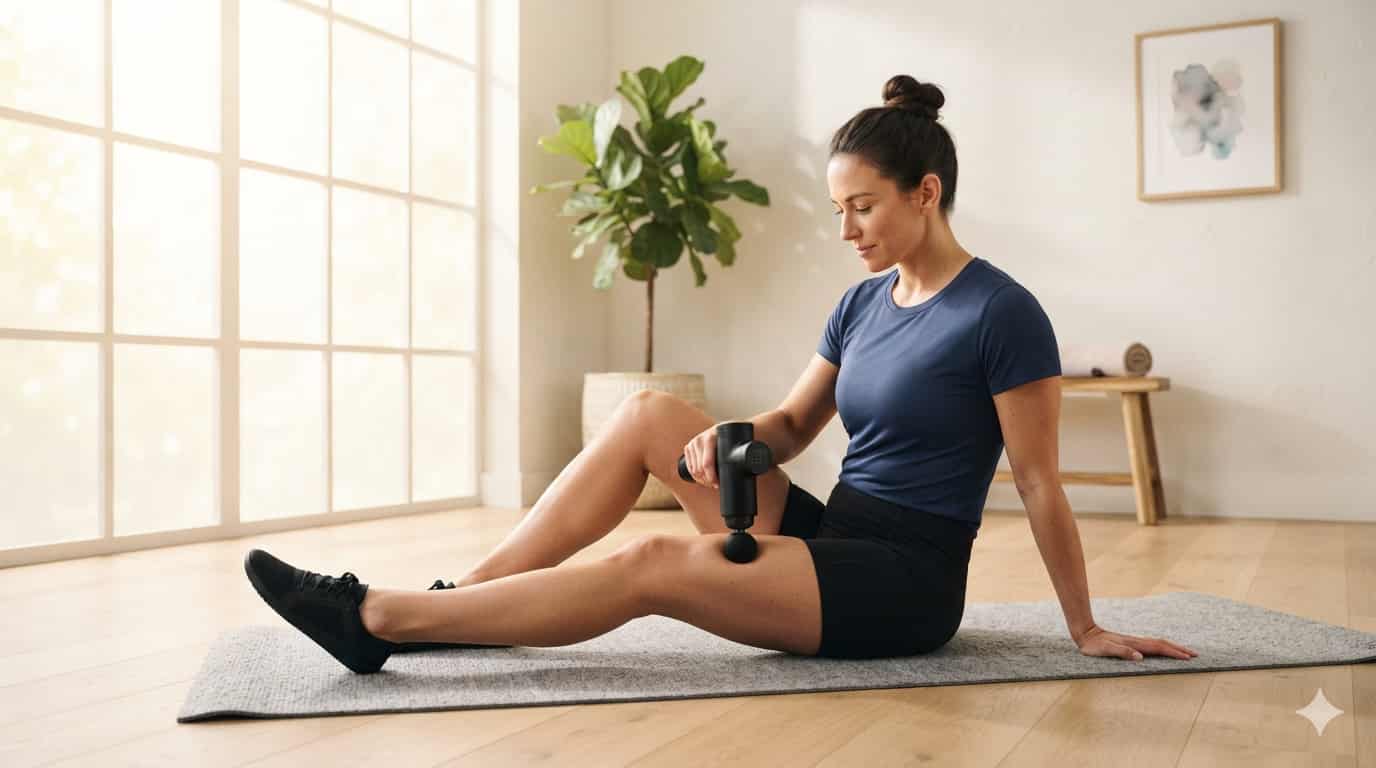
Following a structured massage gun routine for sore legs is one of the most effective ways to accelerate muscle recovery, flush lactic byproducts, and relieve post-workout stiffness without painful tissue bruising. Handheld percussive therapy devices have revolutionized athletic recovery, delivering rapid mechanical pulses deep into muscle bellies to stimulate localized blood circulation.
While percussive therapy devices have exploded in popularity among athletes, executing a disciplined massage gun routine for sore legs ensures that you stimulate microcirculation rather than causing microtrauma to delicate fascia. Many beginners make the painful mistake of grinding the device directly into sensitive bone ridges or pressing down with brute force, leaving behind deep subcutaneous bruises.
Whether you are recovering from heavy barbell squats, long-distance trail running, or hours of standing at work, here are the 7 proven steps to safely unlock your quads, hamstrings, and calves in under 10 minutes.
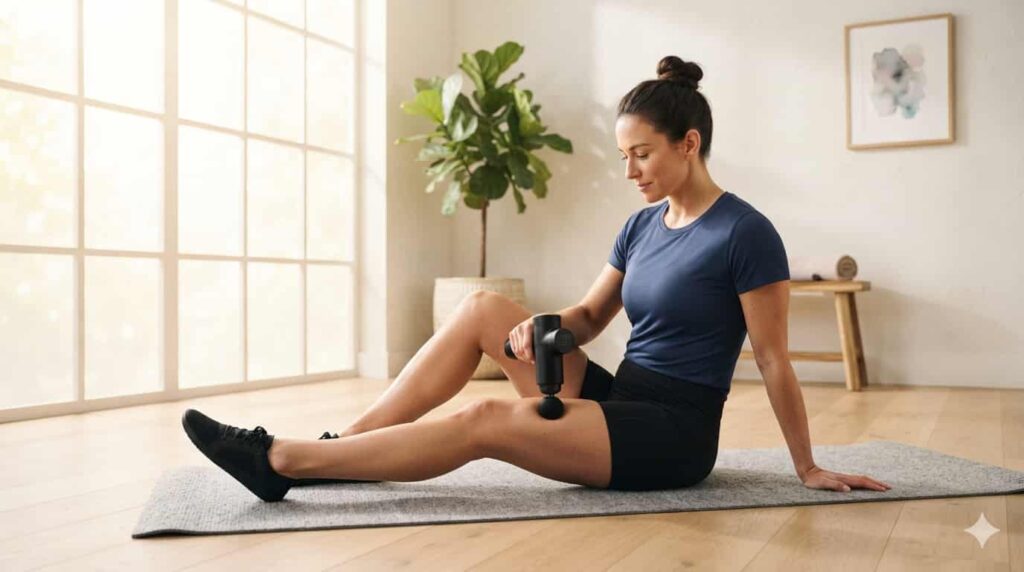
Why You Need a Massage Gun Routine for Sore Legs
Many fitness enthusiasts make the mistake of using percussion tools randomly, but following a targeted massage gun routine for sore legs prevents excessive nerve sensitivity and accidental bone strikes.
When you use percussive therapy systematically, your neuromuscular system benefits from three distinct recovery mechanisms:
- Gate Control Pain Modulation: The high-frequency vibration of a massage gun floods your sensory nerves with tactile input, effectively closing the neural “pain gate” and easing muscular aches.
- Fascial Hydration and Gliding: Rapid percussive strokes unglue sticky cross-links in the connective tissue sheath (fascia), restoring smooth, friction-free movement between muscle layers.
- Lymphatic Flush Without Fatigue: Unlike manual deep-tissue foam rolling—which requires supporting your own bodyweight in awkward planks—a massage gun allows you to relax completely while treating sore tissue.
Implementing a structured massage gun routine for sore legs guarantees optimal muscle flushing while keeping delicate joints completely protected.
7 Proven Massage Gun Routine for Sore Legs Steps for Rapid Relief
1. Quadriceps Sweeps with the Round Ball Head
Starting your massage gun routine for sore legs by gliding along the vastus lateralis and rectus femoris releases heavy tension from squats and running. The dense EVA foam ball attachment delivers broad, forgiving pressure across the large quad belly.
- Attachment: Large round ball head.
- Speed Setting: Low to medium (1,600 to 2,000 PPM).
- Duration: 60 to 90 seconds per leg.
How to Execute:
- Sit comfortably on the floor with your working leg extended straight and completely relaxed.
- Float the massage gun over your mid-thigh, moving slowly from the top of your hip down toward your knee.
- Stop two inches above the patella (kneecap); never run the gun directly over the knee joint.
- Glide slowly at a pace of one inch per second, letting the weight of the device do the work without pushing down.
2. Hamstring Glides on Low Speed
The second phase of an effective massage gun routine for sore legs involves gentle horizontal sweeping across the posterior biceps femoris without digging into the knee crease. Hamstring fibers are dense and easily provoked if excessive force is applied.
- Attachment: Flat head or round ball.
- Speed Setting: Low speed (under 1,800 PPM).
- Duration: 60 seconds per leg.
How to Execute:
- Sit on a chair or the edge of a bed, letting your leg hang loosely.
- Sweep the massage gun from the lower crease of your glute down to the middle of the back of your thigh.
- Avoid the popliteal fossa (the soft hollow behind the knee where major arteries and nerves run close to the surface).
- Spend extra time hovering over tight knots without pressing hard.
3. Calf and Soleus Decompression
Targeting tight lower calves makes your massage gun routine for sore legs essential for preventing Achilles tendonitis and shin splints. Calves endure thousands of repetitive eccentric impacts during running, leading to rigid trigger points in the gastrocnemius.
- Attachment: Soft air-cushion head or round ball.
- Speed Setting: Low speed.
- Duration: 45 to 60 seconds per calf.
How to Execute:
- Sit on the floor and cross your ankle over your opposite knee to expose your calf.
- Glide the device along the thick, fleshy belly of the calf muscle.
- Never strike the thin Achilles tendon at the bottom or the bony tibia bone along the front.
Pairing lower-body mechanical flushing with cardiovascular conditioning like achieving cardiorespiratory fitness keeps your vascular channels primed for continuous nutrient delivery.
4. Gluteus Maximus and Medius Activation
Moving upward into your glutes allows this massage gun routine for sore legs to unlock pelvic tightness that pulls on the lower back. The glute max is the thickest muscle in the body, capable of absorbing deeper percussive amplitude.
- Attachment: Hard flat head or bullet head (for experienced users).
- Speed Setting: Medium to high (2,200 PPM).
- Duration: 90 seconds per side.
How to Execute:
- Lie on your side or stand with your working glute relaxed.
- Move in a circular pattern across the fleshy upper-outer quadrant of your buttocks.
- If you find a tender trigger point, pause the device directly on that spot for 15 seconds without pulsing up and down.
5. Shin and Tibialis Anterior Smoothing with the Flat Head
Using a gentle flat attachment completes your massage gun routine for sore legs by soothing overworked shin muscles. The tibialis anterior muscle controls foot deceleration; when tight, it causes excruciating shin splints.
- Attachment: Flat smooth head.
- Speed Setting: Lowest available speed.
- Duration: 30 seconds per leg.
How to Execute:
- Sit on the floor and locate the fleshy muscle strip running just to the outside of your shin bone.
- Lightly skim the flat head along this muscle strip from just below the knee down toward the ankle.
- Tilt the massage gun slightly away from the center to ensure the vibrating head never rattles against the tibia bone.
6. IT Band Zone Hovering (Fascial Release Without Pain)
Never hammer the thick, fibrous IT band directly on the side of your thigh with high pressure. Instead, sweep the vastus lateralis (the outer quad muscle) directly underneath it. Combining percussive therapy with gentle yoga for mental health training calms the sympathetic nervous system and accelerates deep neuromuscular recovery.
- Target Area: Outer quad boundary, Tensor Fasciae Latae (TFL) at the hip crease.
- Duration: 45 seconds per side.
7. Gentle Foot Arch Drainage
Conclude your session by gently passing the soft-cushion attachment across the plantar surface of your feet for 30 seconds. Relaxing the plantar fascia relieves chain-reaction tension running up through your calves and hamstrings.
Biomechanics: How a Massage Gun Routine for Sore Legs Accelerates Recovery
The scientific advantage of a systematic massage gun routine for sore legs lies in the rapid percussive stroke depth, which desensitizes Golgi tendon organs and downregulates pain perception.
| Muscle Group | Recommended Head | Speed Setting | Target Duration | Common Danger Zone to Avoid |
| Quadriceps | Large Ball Head | Medium (2,000 PPM) | 90 seconds | Directly over kneecap (Patella) |
| Hamstrings | Flat Head | Low (1,600 PPM) | 60 seconds | Soft crease behind knee |
| Calves | Air Cushion Head | Low (1,600 PPM) | 60 seconds | Achilles tendon & shin bone |
| Glutes | Flat or Bullet Head | Medium-High (2,200) | 90 seconds | Sciatic nerve compression / Hip bone |
| Shin (Tibialis) | Flat Head | Lowest Speed | 30 seconds | Direct tibia bone strike |
When to Perform Your Percussive Recovery Session
Performing this 10-minute massage gun routine for sore legs within two hours of training or before bed dramatically reduces delayed onset muscle soreness (DOMS).
Follow these three golden rules for maximum recovery:
- The “Floating” Rule: Never push the massage gun into your flesh; let the natural weight of the motor create percussion. If the gun stalls, you are pressing too hard.
- Maximum 2 Minutes Per Muscle: More is not better. Exceeding two minutes on a single muscle group can cause cellular irritation and rebound inflammation.
- Stay Hydrated: Percussive therapy releases metabolic fluids into the lymphatic system; drink 500ml of clean water following each session to support elimination.
Adopting this practical massage gun routine for sore legs turns an intimidating recovery gadget into your most valuable asset for continuous athletic performance.
Connect With Us & Share Your Progress
For practical recovery tech guides, daily workout routines, and active wellness tips, join our growing digital fitness community:
- Follow our visual exercise diagrams on FitKiter on Pinterest
- Join our community fitness discussions on FitKiter on Facebook