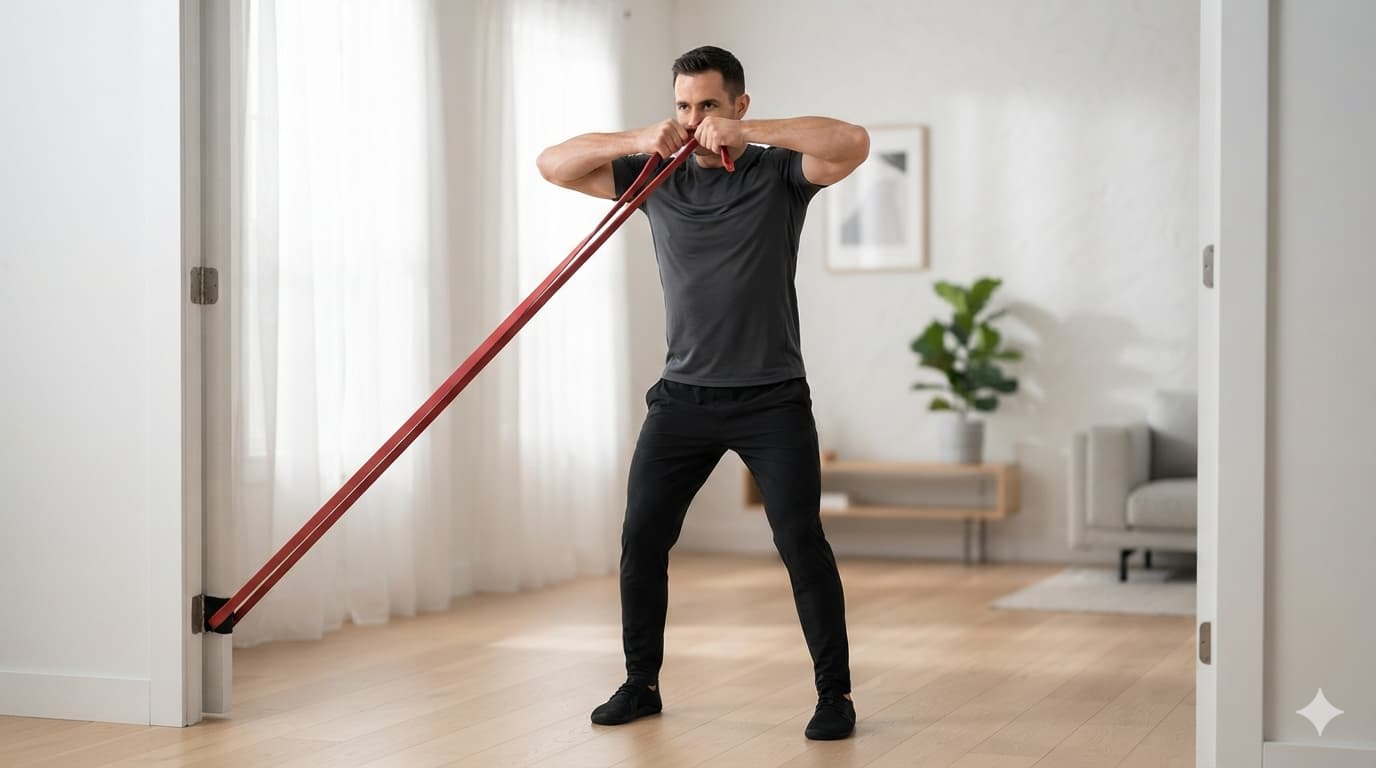
Finding effective resistance band alternatives to cable machines allows you to maintain continuous muscular tension at home without investing in bulky, high-priced gym equipment. Commercial cable crossover towers are fantastic for joint-friendly hypertrophy, but they require massive floor footprints, dedicated ceiling clearance, and thousands of dollars to purchase.
While commercial cable stacks are renowned for smooth continuous resistance, mastering smart resistance band alternatives to cable machines produces comparable hypertrophy outcomes by capitalizing on accommodating elasticity. Resistance bands share the defining quality that makes cable pulleys so unique: they do not rely on gravity, enabling you to apply horizontal and rotational force angles that traditional free-weight barbells cannot match.
Whether you are designing a space-efficient garage gym, traveling for work, or seeking joint-friendly muscle pumps, here are the 7 best exercise swaps you can execute with an affordable set of looped resistance bands.
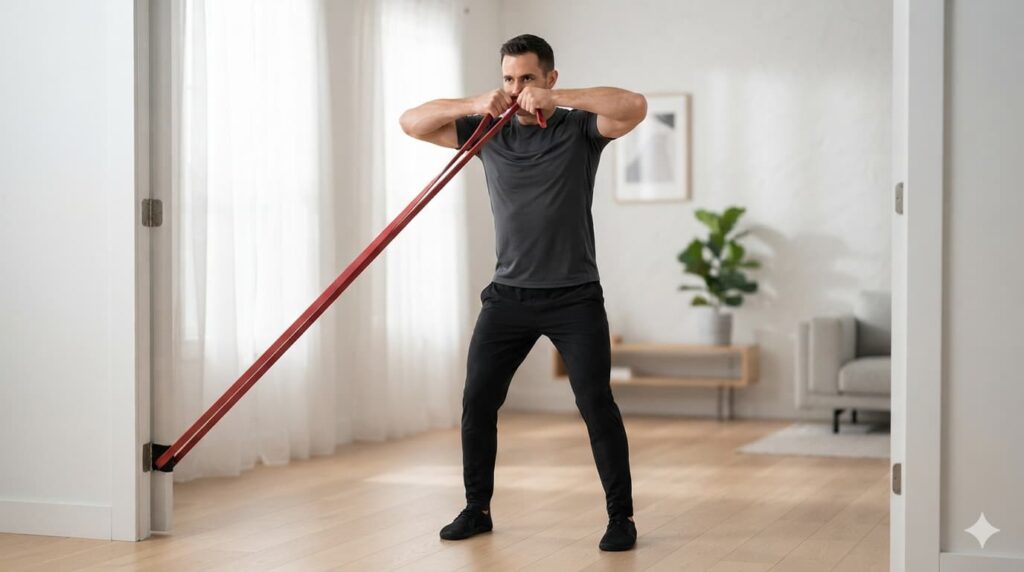
Why Choose Resistance Band Alternatives to Cable Machines?
Many lifters turn to resistance band alternatives to cable machines because commercial dual-pulley towers take up significant room and cost thousands of dollars.
Beyond saving financial capital and floor space, elastic training delivers distinct biomechanical benefits:
- Accommodating Resistance: As a resistance band stretches, its tension exponentially climbs. This matches the human strength curve, demanding peak muscular output exactly where your leverage is mechanically strongest.
- Infinite Directional Vectors: Gravity locks barbells and dumbbells into a strict vertical plane. Elastic bands can be anchored to door frames, bed posts, or your own feet to pull from high, low, or diagonal vectors.
- Rotator Cuff and Joint Longevity: Cable pulleys are gentle on connective tissues, but bands are even friendlier. They deliver a smooth deceleration curve during the negative phase, sparing sensitive elbows and shoulders.
- Ultimate Portability: A full set of calibrated looped bands weighs under two pounds and slips into a carry-on bag, allowing you to train anywhere without missing a workout.
7 Best Resistance Band Alternatives to Cable Machines for Full-Body Muscle
1. Banded Face Pulls (Rear Delts & Posture)
When replacing upper-back pulley work, banded face pulls stand out among the most effective resistance band alternatives to cable machines for building rear deltoids and scapular stability. Commercial gyms utilize high cable pulleys with a rope attachment for this, but an anchored band replicates the exact pull angle.
- Target Muscles: Rear deltoids, rhomboids, middle trapezius, rotator cuffs.
- Equipment Needed: Looped resistance band, door anchor or sturdy post.
How to Perform:
- Secure your band at eye level around a solid anchor point.
- Step back with an overhand grip until you feel medium starting tension with your arms outstretched.
- Pull the band directly toward your eyes while deliberately pulling your hands apart.
- Rotate your wrists upward at the peak contraction so your knuckles face behind you in a double-biceps flex pose.
- Slowly control the return to the start position.
2. Standing Banded Chest Flyes (Pec Isolation)
For isolated chest development, loop band flyes serve as direct resistance band alternatives to cable machines without requiring a wide crossover frame. Because dumbbells lose all horizontal tension at the top of a fly, bands are actually superior to free weights for replicating the continuous squeeze of a cable machine.
- Target Muscles: Sternal pectoralis major, anterior deltoids.
- Equipment Needed: Two resistance bands anchored wide, or a single band looped across your upper back.
How to Perform:
- Anchor the band behind you at mid-chest height (or wrap it across your shoulder blades).
- Step forward into a split stance to establish solid balance.
- With elbows slightly bent, sweep your hands forward in a wide hugging motion.
- Cross your wrists slightly at peak squeeze to maximize inner-chest fiber recruitment.
- Inhale and slowly return your arms out wide until a deep chest stretch is felt.
3. Overhead Kneeling Lat Pulldowns (Back Width)
Anchoring looped bands overhead creates reliable resistance band alternatives to cable machines that torch your latissimus dorsi safely. You do not need a tall commercial lat pulldown station to widen your V-taper.
- Target Muscles: Latissimus dorsi, teres major, biceps brachii.
- Equipment Needed: Heavy looped resistance band, high door anchor.
How to Perform:
- Anchor the band at the top of a sturdy closed door.
- Kneel on the floor facing the anchor point, holding both sides of the band loop with arms extended.
- Brace your abdominal core and drive your elbows downward toward your back pockets.
- Hold the hard muscular contraction for one full second against your ribs.
- Allow the band to pull your arms back up slowly into a full overhead stretch.
For those focusing on spinal decompression alongside back hypertrophy, pairing this movement with yoga for mental health training enhances functional mobility and postural alignment.
4. Overhand Band Tricep Pushdowns (Arm Thickness)
Doing overhead-anchored pushdowns provides one of the cleanest resistance band alternatives to cable machines for locking out arm definition. The variable tension forces your triceps lateral and medial heads to fire with maximum intensity at the lockout.
- Target Muscles: Triceps brachii (lateral, long, and medial heads).
- Equipment Needed: Light to medium continuous-loop band.
How to Perform:
- Loop your band over a high anchor point.
- Grip the band with an overhand neutral grip, pinning your upper arms tight against your ribs.
- Extend your elbows downward until your arms are straight.
- Flay your hands outward slightly at the bottom to achieve peak tricep contraction.
- Return the band back to chest level with a disciplined 3-second eccentric tempo.
5. Standing Low-to-High Woodchoppers (Oblique Power)
Rotational core twists using elastic bands provide functional resistance band alternatives to cable machines without straining your lower back. Unlike static planks, this dynamic exercise conditions your rotational power through the transverse plane.
- Target Muscles: Internal and external obliques, transverse abdominis.
- Equipment Needed: Medium band anchored low.
How to Perform:
- Anchor your band near the floor on your left side.
- Clasp the band with both hands, stepping out until tension builds.
- Rotate your torso diagonally upward across your body from left hip to right shoulder.
- Pivot on your rear foot while keeping your core braced and arms mostly straight.
- Reverse the trajectory under strict control.
6. Seated Band Rows (Mid-Back Thickness)
Seated cable rows are a cornerstone of posture correction, but looping a heavy band around your feet creates identical mechanical tension. If you train in compact spaces where large machines are impractical, combining banded rowing with foldable Pilates machines for home workouts builds an elite, low-impact conditioning studio right in your living room.
- Target Muscles: Rhomboids, mid-traps, posterior deltoids, lats.
- Equipment Needed: Heavy band, floor mat.
How to Perform:
- Sit tall on the floor with your legs straight out in front of you.
- Loop the center of the band securely around both feet.
- Grab the band handles or ends with an upright, neutral spine.
- Retract your shoulder blades and row your hands into your lower abdomen.
- Pause for a squeeze before slowly releasing forward.
7. Banded Bicep Preacher Curls (Bicep Peak)
Replicating an angled cable curl is simple with elastic bands. By keeping your elbows positioned forward against your knees or an incline pad, you take your shoulders out of the equation and focus every ounce of tension on the bicep brachii.
- Target Muscles: Biceps brachii (short and long heads), brachialis.
- Equipment Needed: Light-to-medium band.
How to Perform:
- Sit on a chair and loop the band beneath your feet.
- Rest your elbows on your inner thighs to create a natural preacher curl setup.
- Curl your wrists toward your chin, squeezing hard as the band reaches maximum stretch.
- Lower slowly under continuous control.
Biomechanics: How Resistance Band Alternatives to Cable Machines Deliver Muscle Growth
The scientific brilliance of resistance band alternatives to cable machines lies in accommodating resistance, where peak tension occurs at full muscle contraction. Steel cable weight stacks offer static resistance throughout a rep; bands, however, increase mechanical tension progressively as you reach completion.
| Feature | Commercial Cable Station | Resistance Bands System |
| Footprint / Space | 20 to 50 sq. feet (Bulky) | Fits inside a small drawer |
| Equipment Cost | $1,500 – $3,500+ | $25 – $60 |
| Resistance Profile | Constant resistance throughout | Progressive accommodating tension |
| Portability | Static (Cannot be moved) | 100% portable for travel |
| Joint Wear & Tear | Low | Extremely Low (Safest) |
By pairing these methods with progressive overload, dependable resistance band alternatives to cable machines stimulate deep mechanical tension comparable to traditional steel plates.
How to Program Resistance Band Alternatives to Cable Machines for Progressive Overload
To stimulate continuous muscle growth without heavy iron plates, incorporate these three progressive overload variables:
- Micro-Stretching: Stand an extra 6 to 12 inches further away from the anchor point to increase baseline starting tension.
- Pause at Peak Contraction: Hold every repetition for a full 2-second squeeze at peak band stretch to maximize motor unit recruitment.
- Tempo Manipulation: Lower the band with a strict 4-second eccentric count to trigger high mechanical micro-damage for hypertrophy.
Adopting these versatile resistance band alternatives to cable machines ensures your home fitness journey remains cost-effective, joint-friendly, and consistently progressive.
Connect With Us & Share Your Progress
For visual home workout setups, smart fitness gear recommendations, and daily health routines, join our vibrant wellness community:
- Follow our visual exercise diagrams on FitKiter on Pinterest
- Join our daily fitness discussions on FitKiter on Facebook