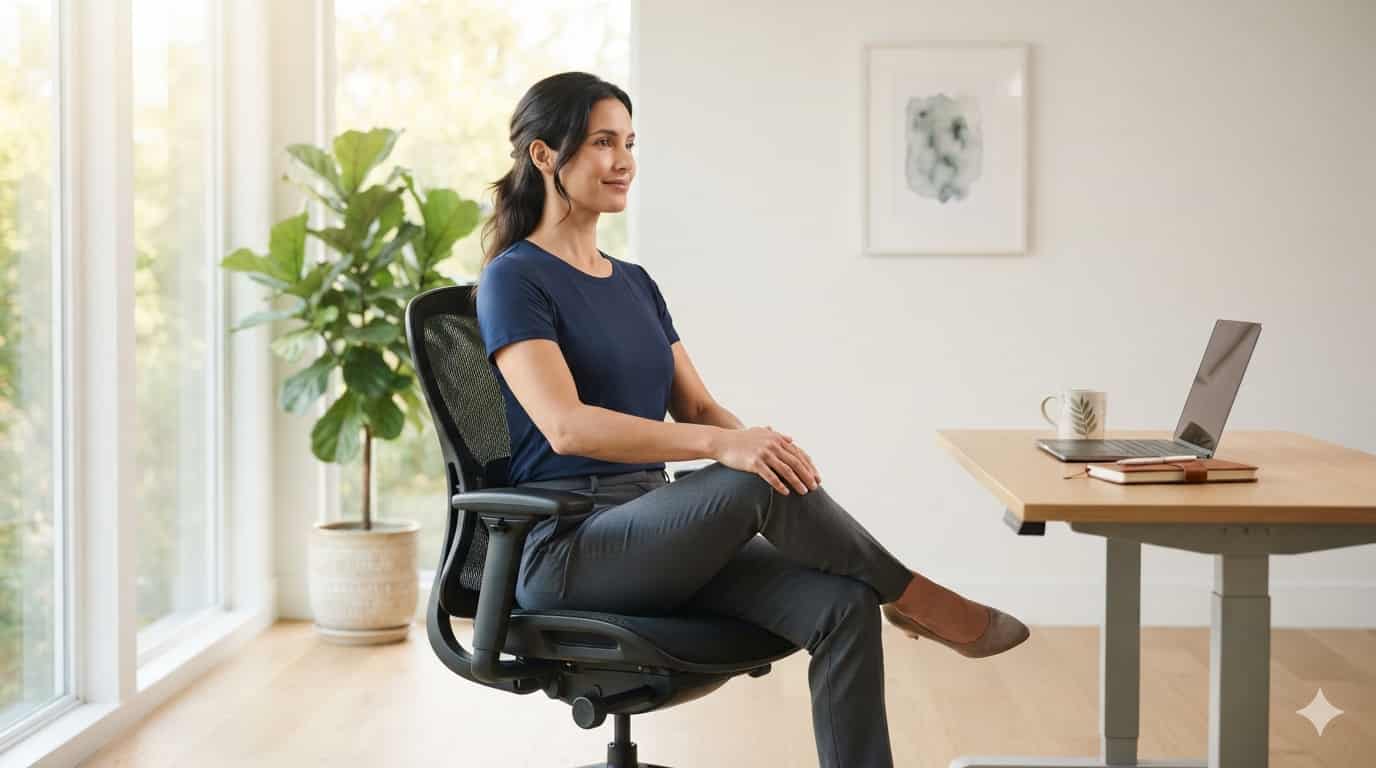
Finding effective desk exercises for lower back pain is essential when long hours of sitting compress your lumbar spine and trigger nagging aches. Sitting passively in an office chair for eight consecutive hours forces your pelvis into a backward tilt, deactivates your gluteal stabilizers, and places heavy static pressure on your intervertebral discs.
While standing desks offer partial help, incorporating targeted desk exercises for lower back pain actively decompresses intervertebral discs and reactivates dormant gluteal muscles right from your office chair. You do not need to roll out an exercise mat or change into gym clothes to relieve lumbar tension. Simple, biomechanically targeted movements performed right at your workstation can restore spinal alignment in minutes.
Whether you work in a corporate cubicle, manage a home office, or spend long hours studying, here are 7 proven chair-friendly exercises that soothe lower back tightness without breaking your workflow.
Why You Need Desk Exercises for Lower Back Pain
Many remote employees and corporate professionals search for desk exercises for lower back pain because static sitting forces the pelvis into a posterior tilt, shortening hip flexors.
When you sit motionless for prolonged periods, three major physical distortions occur:
- Glute Amnesia: When you sit on your glutes for hours, the nervous system downregulates motor recruitment in your posterior chain, leaving your lumbar spine to handle sheer rotational loads.
- Psoas Shortening: Your hip flexors remain in a continuously contracted state, which pulls your lumbar vertebrae forward the moment you attempt to stand.
- Fluid Stagnation in Discs: Spinal discs lack direct blood vessels; they depend on gentle spinal motion to pump in fluid and flush metabolic waste.
Integrating consistent desk exercises for lower back pain interrupts this static stagnation, nourishing your cartilage and relieving nerve pressure before chronic discomfort sets in.
7 Best Desk Exercises for Lower Back Pain You Can Do in Your Chair
1. Seated Figure-Four Piriformis Stretch
Among the most reliable desk exercises for lower back pain, the seated figure-four stretch releases tension in the deep piriformis muscle that often mimics sciatic nerve pain. Tight deep hip rotators pull directly on the sacrum, radiating dull aches into your lower back.
- Target Muscles: Piriformis, gluteus medius, hip rotators.
- Duration: Hold for 30 seconds per side.
How to Perform:
- Sit tall near the front edge of your office chair with your feet flat on the floor.
- Lift your right ankle and rest it across your left knee, creating the shape of the number 4.
- Keep your spine long and proud; gently press your right knee downward toward the floor.
- Hinge slightly forward from your hips (do not round your upper back) until you feel a deep, relieving stretch deep in your right hip.
- Inhale deeply for three breath cycles, then switch legs.
2. Seated Cat-Cow Spinal Articulation
Adding a gentle seated Cat-Cow makes for one of the smoothest desk exercises for lower back pain, mobilizing stiff thoracic and lumbar vertebrae without standing up. It introduces micro-movements that pump fresh fluid directly into compressed lumbar cushions.
- Target Muscles: Erector spinae, rectus abdominis, thoracic spine.
- Duration: 8 to 10 slow breath cycles.
How to Perform:
- Plant both feet flat on the floor and rest your hands lightly on your knees.
- Inhale deeply, rolling your shoulders back, lifting your chest, and slightly arching your back (Cow position).
- Exhale fully, tucking your chin toward your chest and rounding your spine against the back of your chair (Cat position).
- Flow smoothly between these two shapes without forcing extreme ranges of motion.
3. Seated Chair Torso Twist
Performing a controlled seated spinal twist is another staple among desk exercises for lower back pain, restoring rotational mobility lost from hours of staring at dual monitors. Rotational decompression opens the facet joints where spinal nerves exit.
- Target Muscles: Internal and external obliques, spinal rotators.
- Duration: 20 seconds per side.
How to Perform:
- Sit upright with knees and feet glued together.
- Place your right hand on the outside of your left knee and grip the armrest or back of your chair with your left hand.
- Inhale to lengthen your crown toward the ceiling, then exhale and gently rotate your ribcage to the left.
- Keep your hips facing straight forward so the twist originates entirely from your mid-and-lower torso.
4. Standing Desk Hip Flexor Lunge
If your desk allows you to stand, lunging forward with one foot back represents one of the most powerful desk exercises for lower back pain to reverse chronic hip flexion. Lengthening the psoas immediately stops the anterior tug-of-war on your lower spine.
- Target Muscles: Iliopsoas, rectus femoris, core stabilizers.
- Duration: 30 seconds per leg.
How to Perform:
- Stand next to your desk and place one hand on the desk surface for balance.
- Step your right leg straight back into a shallow split lunge, keeping your back heel elevated.
- Tuck your tailbone under (posterior pelvic tilt) and squeeze your right glute firmly.
- You will immediately feel a profound opening across the front of your right hip crease.
Pairing these daily posture resets with consistent achieving cardiorespiratory fitness keeps your metabolic rate elevated and counters the cardiovascular risks of prolonged sitting.
5. Seated Pelvic Tilts (Subtle Chair Rocking)
Subtle anterior and posterior pelvic rocking stands out as one of the most discreet desk exercises for lower back pain that pumps restorative blood flow into lumbar discs. You can do this during team calls without anyone noticing.
- Target Muscles: Transverse abdominis, multifidus, pelvic floor.
- Duration: 15 slow repetitions.
How to Perform:
- Sit comfortably upright away from the backrest.
- Inhale and roll your pelvis forward, creating a mild arch in your lower back.
- Exhale and tilt your pelvis backward, flattening your lumbar curve and gently drawing your belly button inward.
- Repeat this rhythmic rocking to stimulate blood flow through the sacral junction.
6. Seated Hamstring Reach
Tight hamstrings tether your ischial tuberosities (sitting bones), dragging your pelvis down into an unhealthy slump. Loosening them from your chair restores natural spinal curvature instantly.
- Target Muscles: Biceps femoris, semitendinosus, calves.
- Duration: 30 seconds per leg.
How to Perform:
- Perch on the edge of your seat and extend your left leg straight in front of you, heel on the carpet and toes pointing up.
- Place your hands on your right thigh for stability.
- Keep your chest elevated and lean gently forward from the hip crease until you feel a clean hamstring stretch.
7. Standing Desk Chest and Thoracic Extension
Round-shouldered slumping forces your lower spine to compensate for upper-back collapse. Concluding your micro-break with an open-door chest expansion restores upright vertical posture. Pairing postural corrections with calming yoga for mental health training resets your nervous system and dramatically diminishes work-related mental stress.
- Target Muscles: Pectoralis major, anterior deltoids, thoracic extensors.
- Duration: 5 slow diaphragmatic breaths.
Biomechanics: How Desk Exercises for Lower Back Pain Decompress Your Spine
The therapeutic mechanism of consistent desk exercises for lower back pain lies in interrupting sustained static load and restoring natural lordotic curvature.
| Exercise | Primary Target | Mechanical Action | Workplace Discretion |
| Figure-Four Stretch | Piriformis & Hips | Deep External Hip Rotation | Very High (Seated) |
| Seated Cat-Cow | Full Vertebral Column | Flexion & Extension Pumping | High (Seated) |
| Chair Torso Twist | Facet Joints & Obliques | Axial Thoracic Rotation | High (Seated) |
| Desk Hip Flexor Lunge | Iliopsoas / Hip Crease | Hip Extension & Glute Drive | Moderate (Standing) |
| Seated Pelvic Tilts | Sacroiliac Joint | Pelvic Rhythm Articulation | Maximum (Invisible) |
Daily Workflow: How to Integrate These Stretches
Doing these gentle desk exercises for lower back pain for just two minutes every hour keeps your postural stabilizers engaged throughout long shifts.
To build an effortless habit:
- Set an Hourly Chime: Use a subtle desktop reminder to step away from typing for two minutes at the 50-minute mark of every hour.
- Alternate Stretches: Pick two seated stretches in the morning and two standing stretches in the afternoon.
- Breathe Through Your Nose: Nasal diaphragmatic breathing expands your lower ribcage, which physically unloads tension from your lumbar spine.
Integrating these practical desk exercises for lower back pain ensures that your workday productivity never comes at the expense of your spinal health.
Connect With Us & Share Your Progress
For practical workplace posture tips, home wellness routines, and daily exercise guides, join our growing digital health community:
- Follow our visual exercise flows on FitKiter on Pinterest
- Join our health and posture discussions on FitKiter on Facebook