Practicing a consistent evening stretch routine for better sleep is one of the most natural ways to calm an overstimulated nervous system and release daytime physical tension. After spending hours hunching over keyboards, navigating chaotic commutes, and processing relentless smartphone notifications, your muscles remain locked in a defensive, semi-contracted state.
While heavy night workouts can disrupt circadian rhythms, adopting a gentle evening stretch routine for better sleep signals your autonomic nervous system to downshift into parasympathetic recovery. Vigorous exercise late in the evening spikes core body temperature and cortisol, making sleep elusive. In contrast, slow, passive stretching paired with nasal diaphragmatic breathing lowers resting heart rate, dilates blood vessels, and prepares your brain for restorative slow-wave sleep.
Whether you toss and turn for hours, wake up with a stiff lower back, or struggle to quiet your racing mind before bed, here are 7 calming drills you can do right on your bedroom carpet or mattress in under 10 minutes.
Why You Need an Evening Stretch Routine for Better Sleep
Many modern professionals turn to an evening stretch routine for better sleep because hours of blue light exposure and mental deadlines keep cortisol levels artificially elevated at night.
When you climb into bed with physical tension, three major sleep inhibitors take place:
- Sympathetic Hyperarousal: The nervous system remains trapped in “fight-or-flight” mode, preventing your brain waves from transitioning from active beta waves into calm alpha and theta frequencies.
- Elevated Core Temperature: Tense muscle fibers trap heat; your body must lower its internal temperature by approximately two degrees Fahrenheit to initiate melatonin secretion.
- Nocturnal Muscle Spasms: Chronic tightness in the hamstrings and hip flexors triggers micro-arousals during the night, fragmenting your rapid eye movement (REM) cycles.
Committing to a restorative evening stretch routine for better sleep releases stored kinetic tension and drops systemic blood pressure before your head touches the pillow.
7 Proven Drills in This Evening Stretch Routine for Better Sleep
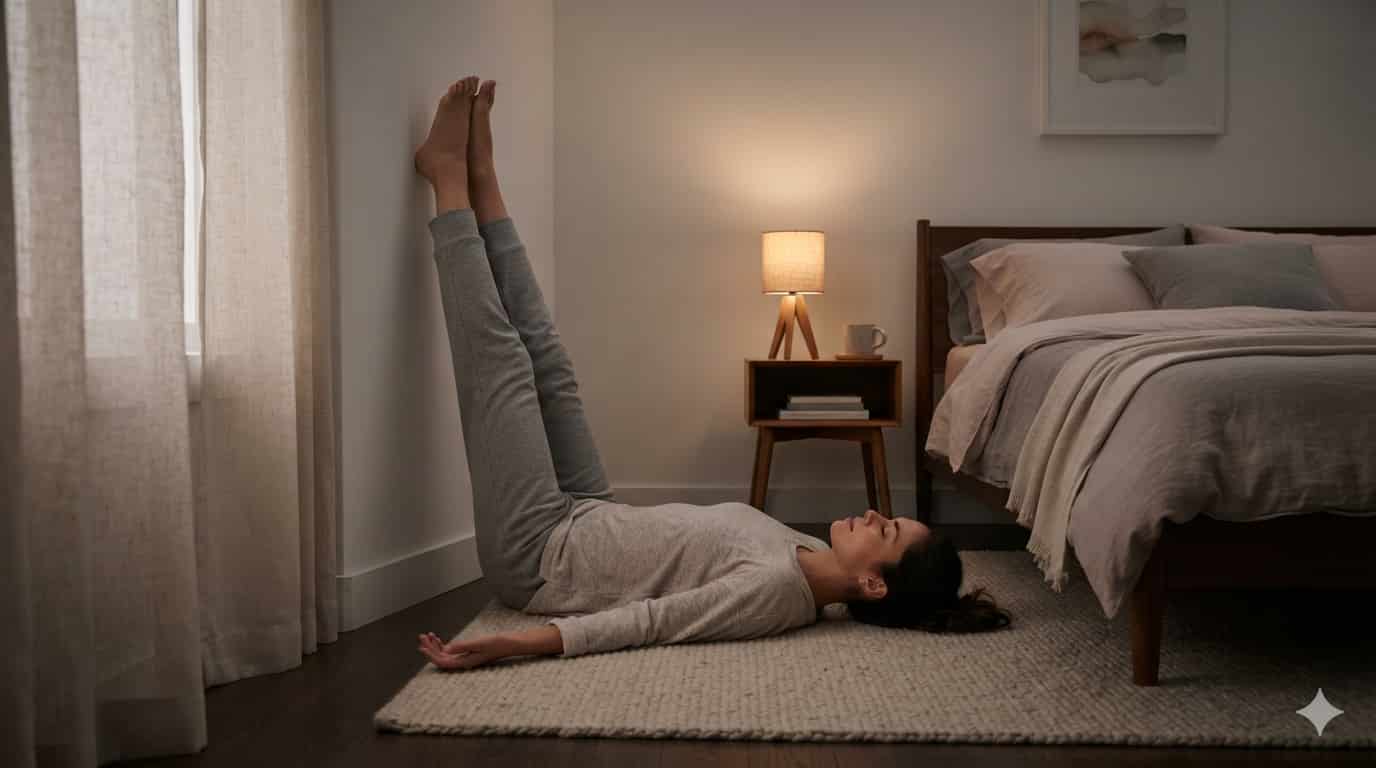
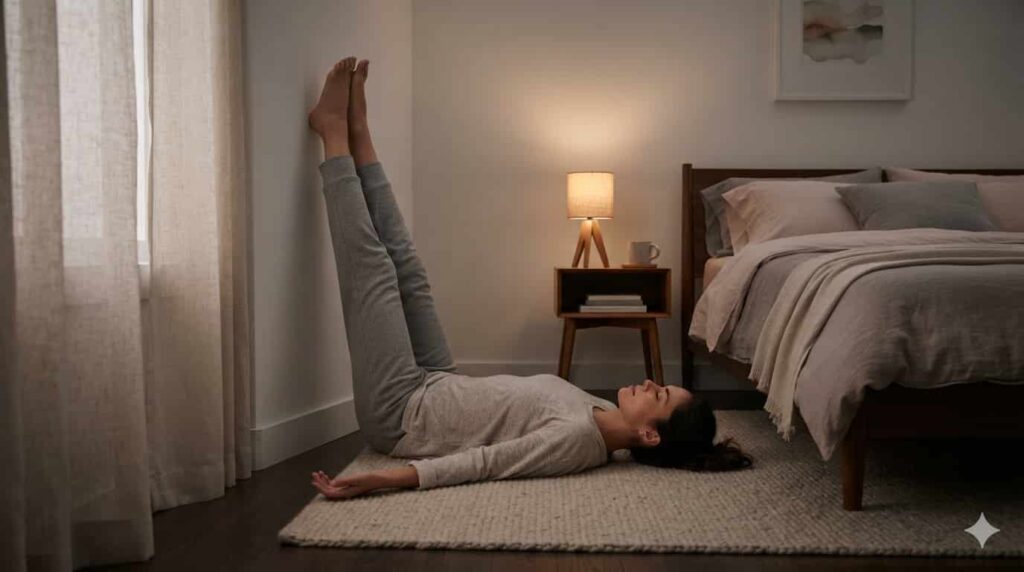
1. Legs-Up-the-Wall Pose (Viparita Karani)
Anchoring this evening stretch routine for better sleep with the restorative Legs-Up-the-Wall posture drains pooled venous blood from tired feet and drops blood pressure. Gravity assists lymph circulation back toward your core, relieving heavy, swollen legs after long hours of standing or sitting.
- Target Areas: Hamstrings, lower back, lymphatic and venous return.
- Hold Time: 2 to 3 minutes.
How to Perform:
- Sit sideways against an empty wall, then swing your legs upward as you gently lower your shoulders and head to the floor.
- Rest your glutes as close to the baseboard as comfortable, letting your heels rest against the wall with straight or softly bent knees.
- Place your hands on your lower abdomen, close your eyes, and take long, deep breaths through your nose.
- Feel your lower back sink naturally flat against the carpet.
2. Supported Extended Child’s Pose (Balasana)
Transitioning into extended Child’s Pose serves as another foundational movement in an evening stretch routine for better sleep, gently decompressing the lumbar vertebrae. This grounding posture signals emotional safety and unloads weight from the hips and spinal column.
- Target Areas: Latissimus dorsi, thoracic spine, hips, ankles.
- Hold Time: 60 to 90 seconds.
How to Perform:
- Kneel on your mat or mattress with your big toes touching and knees spread wide.
- Fold your torso forward, resting your chest between your thighs and placing your forehead lightly on the floor.
- Extend your arms out in front of you with palms flat, or drape them alongside your hips for deeper shoulder release.
- Direct each inhale into the back of your lungs, expanding your ribcage.
3. Gentle Supine Spinal Twist (Supta Matsyendrasana)
Incorporating supine spinal twists into your evening stretch routine for better sleep releases rotational tension built up from desk sitting. Wringing out the spine stimulates the vagus nerve, which immediately soothes digestive stress.
- Target Areas: Obliques, lower back extensors, gluteus medius, chest.
- Hold Time: 45 seconds per side.
How to Perform:
- Lie flat on your back, hug your right knee into your chest, and extend your left leg long.
- Guide your right knee across your body toward the floor on your left side using your left hand.
- Extend your right arm out to the side like a wing and turn your head gently toward your right fingertips.
- Let gravity draw your knee down without forcing it to touch the ground.
- Inhale back to center and repeat on the opposite side.
4. Reclined Butterfly Pose (Supta Baddha Konasana)
Adding a supported butterfly stretch makes your evening stretch routine for better sleep deeply restorative for tight pelvic and groin tissues. Sitting passively all day shortens the inner adductors; opening them restores natural pelvic alignment.
- Target Areas: Adductor groin muscles, anterior hip capsule, chest.
- Hold Time: 90 seconds.
How to Perform:
- Lie on your back with knees bent and feet flat on the floor.
- Let your knees fall open naturally to the sides, pressing the soles of your feet together.
- Place a pillow beneath each knee if your hips feel overly strained.
- Rest one hand over your heart and one hand over your belly, feeling the rhythmic rise and fall of your breathing.
5. Seated Neck and Trapezius Lateral Release
Releasing upper-body rigidity with slow side neck sweeps is an indispensable part of any evening stretch routine for better sleep. Tension headaches and jaw clenching originate in overworked upper trapezius and levator scapulae muscles.
- Target Areas: Upper trapezius, scalenes, cervical spine extensors.
- Hold Time: 30 seconds per side.
How to Perform:
- Sit cross-legged with an upright, relaxed spine.
- Drop your right ear softly toward your right shoulder without lifting the shoulder up.
- Place your right palm lightly over the crown of your head to add gentle, passive weight (do not pull).
- Breathe deeply into the left side of your neck, feeling the muscle fibers soften.
- Slowly release and switch to the opposite side.
6. Cat-Cow Breathing Flow on Mattress
Before slipping beneath your duvet, performing four slow Cat-Cow breath cycles right on your mattress mobilizes spinal discs. While engaging in daytime aerobic conditioning like achieving cardiorespiratory fitness fuels energy during sunlight hours, slow nocturnal articulation winds your system down.
- Target Areas: Entire spinal column, abdominal wall.
- Hold Time: 6 slow breath cycles.
How to Perform:
- Position yourself on hands and knees on the mattress.
- Inhale smoothly, arching your lower back slightly and opening your chest.
- Exhale fully, drawing your navel to your spine and rounding your back toward the ceiling like a stretching cat.
7. Savasana with 4-7-8 Breathing
Concluding your movement with absolute stillness on your back anchors the physiological benefits of your practice. Integrating mindfulness with restorative yoga for mental health training quiets bedtime racing thoughts and eases psychological anxiety effortlessly.
- Target Areas: Full-body neuromuscular release.
- Protocol: Inhale for 4 seconds, hold for 7 seconds, exhale slowly for 8 seconds. Repeat 4 times.
Biomechanics: How an Evening Stretch Routine for Better Sleep Promotes Deep Rest
The underlying physiology of an evening stretch routine for better sleep involves activating the vagus nerve to decrease nocturnal resting heart rate.
| Stretch Movement | Anatomical Target | Nervous System Impact | Ideal Location |
| Legs-Up-the-Wall | Venous Return & Hamstrings | Blood Pressure Reduction | Floor / Wall |
| Child’s Pose | Lumbar & Thoracic Spine | Parasympathetic Reset | Carpet or Mattress |
| Supine Twist | Facet Joints & Abdomen | Vagus Nerve Stimulation | Bed or Floor Mat |
| Reclined Butterfly | Pelvic Floor & Adductors | Deep Hip Tension Release | Mattress with Pillows |
| Neck Release | Cervical Trapezius | Relieves Clenched Jaw & Headaches | Seated in Bed |
Designing Your Perfect Bedroom Wind-Down Environment
Setting aside just ten minutes in low lighting for this evening stretch routine for better sleep establishes an unshakeable physiological boundary between work and rest.
To maximize the impact:
- Dim the Lights: Turn off overhead LEDs and use warm 2700K ambient lamps or candlelight to encourage natural melatonin release.
- Keep the Room Cool: A bedroom temperature around 65°F to 68°F (18°C to 20°C) facilitates rapid sleep onset following stretching.
- No Phone Screen During Stretches: Leave your smartphone on the bedside table and focus entirely on the physical sensation of your breath.
Committing nightly to this relaxing evening stretch routine for better sleep guarantees that you drift off quickly and wake up revitalized for the day ahead.
Connect With Us & Share Your Progress
For practical evening routines, daily wellness tips, and healthy lifestyle guidance, join our growing digital community:
- Follow our visual evening wind-down routines on FitKiter on Pinterest
- Join our community discussions on FitKiter on Facebook